
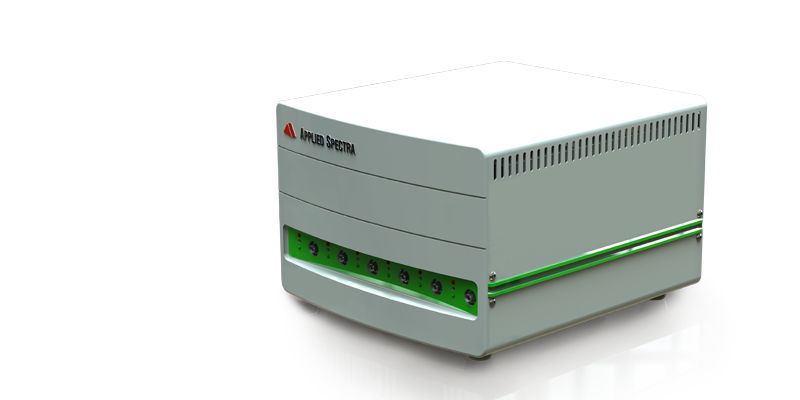
Aurora LIBS Spectrometer
Not all LIBS spectrometers are created equal. The Aurora LIBS Spectrometer—designed by the LIBS experts at Applied Spectra—delivers the high spectral resolution and precise gate timing control required for effective LIBS analysis.
Aurora’s flexible number of spectrometer channels makes it an ideal detector for broadband as well as narrower band analysis focusing on a few specific elements. And Aurora features integrated data analytics, including our TruLIBS™ emission database and LIBS GDT (Graphical Development Tool) chemometric software; together, these enable our customers to rapidly identify complex emission peaks and process LIBS spectra for accurate quantitative and material forensic analysis.
Not Just a Component—A Complete LIBS Spectrometer Solution
The LIBS experts at Applied Spectra have a long and successful history delivering LIBS instrument solutions to researchers and industrial customers. We applied this expertise and experience to Aurora’s hardware design and software features. Aurora strikes the right balance between spectral resolution and detection sensitivity—from UV to NIR spectral ranges. Don’t waste time wondering if you have the right spectrometer configuration. Aurora lets you focus attention on your applications or research.
The Aurora LIBS Spectrometer
-
Customizable 3 to 6 spectrometer channels
-
Balanced performance between spectral resolution and detection sensitivity
-
Integrated pulse generator for laser and gating parameter control
-
Accurate gate delay control down to 50 ns with low jitter
-
Integrated data processing software
-
Powerful chemometric software for sample classification
LIBS Application Notes
LIBS for Macronutrient and Micronutrient Analysis in Soil
 Laser-induced breakdown spectroscopy (LIBS) offers the ability to analyze soil samples with little sample preparation, provides detection of all elements in the periodic table, and has a large dynamic range (ppm to wt. %).
Rapid Analysis of Mining Samples Using Laser Induced Breakdown Spectroscopy (LIBS)
 Laser-induced breakdown spectroscopy (LIBS) offers many attractive analytical advantages with respect to other techniques for the mining industry. LIBS can detect elements from H – Pu, which includes non-metals, such as H, N, F, and O, along with high sensitivity for lighter elements (B, Li, C, K, Ca, Mg, Al, Si, etc.)