
Blog
Classification of Edible Salt Products by Tandem LA-ICP-MS and LIBS Analysis
Combining LA-ICP-MS and LIBS data in a single tandem measurement improves classification of edible salts by geographical origin using chemometric models.
By Dr. Yonghoon Lee, Department of Chemistry, Mokpo National University, Republic of Korea · Food & Authentication
Laser induced breakdown spectroscopy (LIBS) and laser ablation inductively coupled plasma mass spectrometry (LA-ICP-MS) have both been studied for the classification of materials by their chemical fingerprints. This blog highlights research by Dr. Yonghoon Lee and colleagues on the classification of edible salt products by their geographical origin using tandem LA-ICP-MS and LIBS analysis.
Edible salt is consumed worldwide, and its price and perceived quality vary considerably with its geographical origin. Because premium salts command higher prices, there is an incentive for mislabeling and adulteration, which makes reliable methods for verifying the origin of salt products valuable for both consumers and regulators.
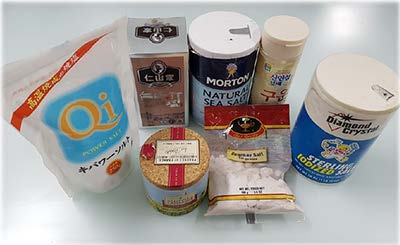
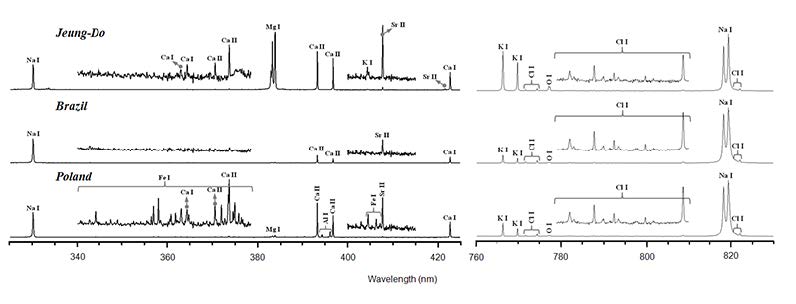
LIBS is a fast, direct technique that requires little sample preparation. A pulsed laser is focused onto the salt to create a microplasma, and the emission from the plasma is analyzed to determine the elemental composition. The resulting spectra serve as a chemical fingerprint of the salt.
The accuracy of classification can be improved by combining LIBS with LA-ICP-MS, which provides highly sensitive detection of trace elements. In a tandem measurement, both LIBS and LA-ICP-MS data are collected from the same laser ablation event, so the two data sets are perfectly registered to the same sample material.
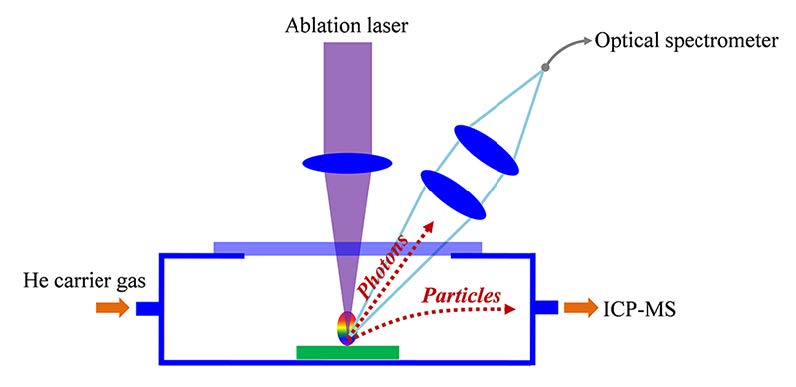
LIBS detects photons emitted by the plasma and is sensitive to major and light elements, while LA-ICP-MS samples the ablated particles and is sensitive to trace elements and isotopes. Together they provide a more complete elemental description of each salt than either technique alone.
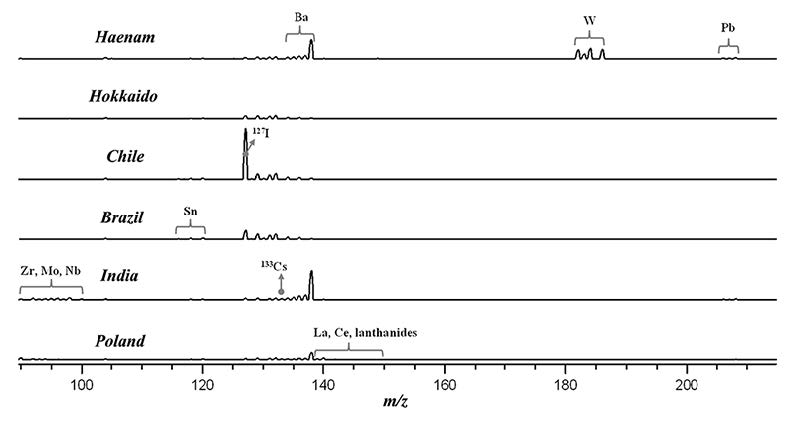
The combined LIBS and LA-ICP-MS spectra provide an ideal data set for multivariate classification. Principal component analysis (PCA) was used to visualize the separation of the salts by origin, and the score plots show clustering of samples according to their geographical source.
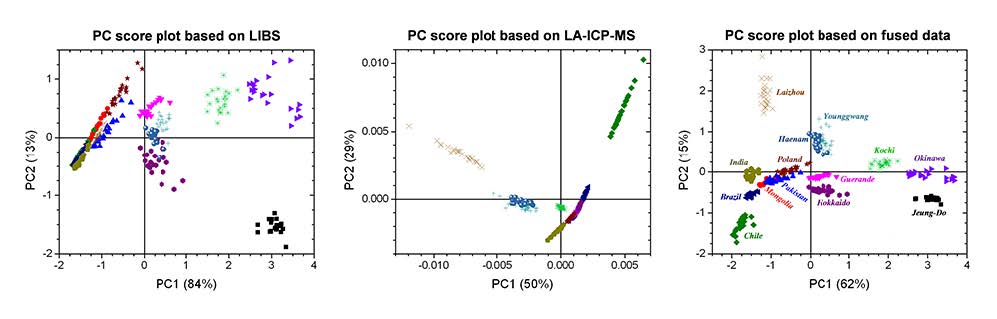
The evaluation of partial least squares discriminant analysis (PLS-DA) models showed that classification based on the combined tandem data outperformed models based on LIBS or LA-ICP-MS data alone.
The model based on the combined data achieved the highest classification accuracy, demonstrating the value of collecting LIBS and LA-ICP-MS data in a single tandem measurement. This work was carried out in research and development collaboration and is published in Spectrochimica Acta Part B: Atomic Spectroscopy.
In recent years, LIBS and LA-ICP-MS have increasingly been used together, and the tandem approach represents a promising direction for future hyphenated analytical techniques that combine the complementary strengths of both methods.