
Customer News
Center for Research and Restoration of Museums, Louvre Celebrates the Inauguration of Applied Spectra’s RESO-EX Laser Ablation Instrument
Posted on
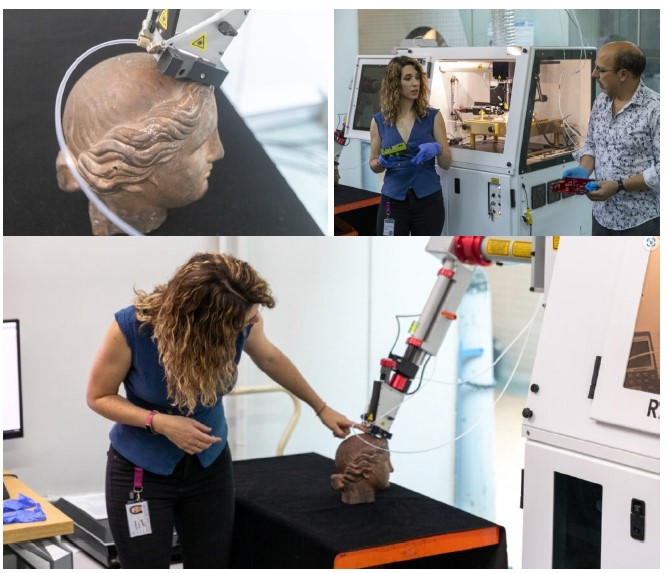
On October 19, 2023, the Center for Research and Restoration of Museums of France (C2RMF) had the joy of celebrating the inauguration of a new instrument intended for the study of heritage materials: the LA-ICP-MS, a laser ablation inductively coupled plasma mass spectrometer. New research perspectives are opening up to researchers and collection managers.
A new instrument at the service of research
The instrument that was inaugurated is an essential complement to the techniques already available at the C2RMF and within the Île-de-France heritage sciences community. It appeared necessary to go further in sensitivity to certain chemical elements, further in chemical imaging, and further in the exploration of the layers present on the surface of the works. It was also necessary to offer, alongside elemental chemical analysis, the possibility of isotopic analysis.
This is what mass spectrometry and its coupling with laser ablation allows. This unique prototype, developed exclusively for the C2RMF, offers even more: the offset arm makes it possible to overcome the limitation to small objects usually imposed by this type of instrument. Very large works can now be placed in front of the laser.
The C2RMF: a research center in constant improvement
As a nationally competent service of the Ministry of Culture, the C2RMF’s mission is, among other things, to constitute, in collaboration with collection managers, documentation on the materials of museum works and heritage collections more generally. These materials are very diverse and often difficult to access, so limiting the invasive side of analytical techniques to the strict minimum is a constant concern. Documenting these materials often constitutes a challenge: you have to be able to say a lot from a little.
To do this, the C2RMF conducts a permanent technological watch around the latest analysis methods available, which it then adapts to its very specific constraints. The NEW AGLAE accelerator is the most obvious example, having attracted world-renowned French and international teams for more than twenty years. The ATRAMAP platform was born in this wake and, thanks to the financial support of the Île-de-France region and the Ministry of Culture, will be able to grow.
This project was made possible thanks to the support of nine partners who joined forces with the C2RMF: two national museums (the Louvre Museum and the MAN), a Ministry of Culture laboratory dedicated to the study and conservation of heritage (LRMH), a CEA/CNRS laboratory (LAPA/NIMBE), four CNRS/University laboratories dedicated to archaeology and archaeometry (ARSCAN, LGP, MSHM, TIME), and a French school abroad (French School of the Far East).
In the coming weeks, the C2RMF will analyze the statuary group of Taharqa and Hémen, one of the most famous Egyptian works in the Louvre Museum. At the same time, a portal will be set up to formalize requests for access to the platform, and a scientific council of around ten members will evaluate and select these applications. Opening the platform to the entire DIM PAMIR community will be made possible thanks to the support of C2RMF partners.